Compound Interest Calculator
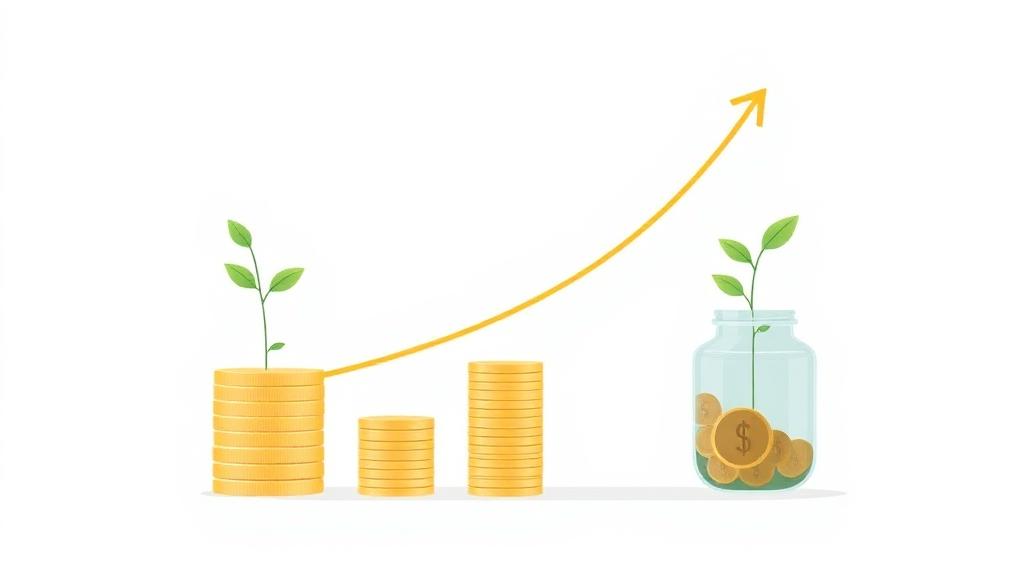
See how your savings grow over time with a compound interest calculator built to help you compute compound interest quickly across different rates, time horizons and compounding frequencies.
What Compound Interest Means
Compound interest is what you earn when the interest your money generates is added back to the balance and starts earning interest itself. Unlike simple interest, where returns stay flat, compounding creates a snowball effect that drives long-term wealth. The standard formula is A = P(1 + r/n)^(nt).
By entering principal, annual rate, years and compounding frequency you instantly see the future value and total interest earned — useful for fixed deposits, retirement accounts, mutual funds and everyday savings.
How to Use the Tool
Enter your starting amount, annual rate, time horizon in years and how often interest compounds (12 for monthly, 4 for quarterly, 1 for yearly, 365 for daily). The future value and interest earned update instantly, so you can experiment with any scenario.
Lengthen the time horizon to see how compounding rewards patience. Bump the rate by even a single percentage point to watch the future value rise. It's the easiest way to see why starting early matters more than investing more later.
Compounding Frequency
Set the frequency to 1 for yearly compounding, 4 for quarterly, 12 for monthly or 365 for daily. More frequent compounding produces marginally higher returns. For most savings accounts and CDs, monthly is standard.
A common mistake is comparing headline rates without checking frequency. A 6% rate compounded monthly outperforms 6% compounded yearly even though the quoted rate is identical — try both side by side to see the gap.
If you want practical examples around savings habits and long-term growth, read our blog and compare wealth-building math with loan costs using the equated monthly installment calculator.
Why It Matters
Compound interest is the engine behind long-term wealth. A $10,000 investment compounding at 8% for 30 years grows to roughly $100,000 without a single extra contribution. The earlier you start, the more time works in your favour.
Use this alongside our EMI calculator to see the cost of borrowed money — the flip side of compounding.
FAQs
What does this calculator do?
It projects future value and interest earned by applying the standard compound interest formula to your inputs.
Can I model monthly contributions?
This version computes growth on a single deposit. Use it iteratively to model recurring contributions.
Is the result before or after tax?
Pre-tax. Subtract your applicable tax rate on interest income for an after-tax estimate.
What rate should I use?
Use your account's APY for savings, or a conservative long-term return (e.g. 6–8%) for investments.
Does compounding frequency really matter?
Yes — daily compounding marginally beats monthly, which beats yearly.